
Commerce is changing.
A customer says: “Find the best option for my next trip, keep it within budget, use my preferred card and only check back with me if something falls outside my rules.” The agent compares options, applies preferences and payment credentials, and moves from recommendation to action with the right controls in place. This is agentic commerce in action.
Agentic commerce is not simply a new channel or a more sophisticated chatbot. It is a new orchestration layer between customer intent, decision-making and execution. It enables AI agents to move beyond recommendations and, with the appropriate permissions and controls, take action on behalf of users.
For banks, this raises a fundamental question: if AI can increasingly act autonomously on our behalf, how do we ensure every action reflects the customer’s intent and remains trusted, secure and authorised? Answering it requires the infrastructure to define permissions, enforce controls and preserve a clear record of what was done, by whom and within whose authority.
Building accountability into autonomy
The breakthrough is not that AI can make recommendations. It is that AI can increasingly act.
As agents become participants in commerce, payments evolve from the final step in a transaction to the control layer for trusted, authorised action. Authentication, permissions, spending controls and auditability are no longer supporting capabilities. They become foundational infrastructure.
The good news is that banks do not need to start from scratch. Many of the building blocks already exist. The challenge is adapting payments, identity, risk and operating models for a world where customers increasingly delegate decisions and transactions to trusted agents.
This is where Visa’s advisory practice can help. We work with clients to move from awareness to readiness, helping them identify the right opportunities, assess organisational preparedness and build a roadmap from pilot to scale.
1. Design for trusted autonomy
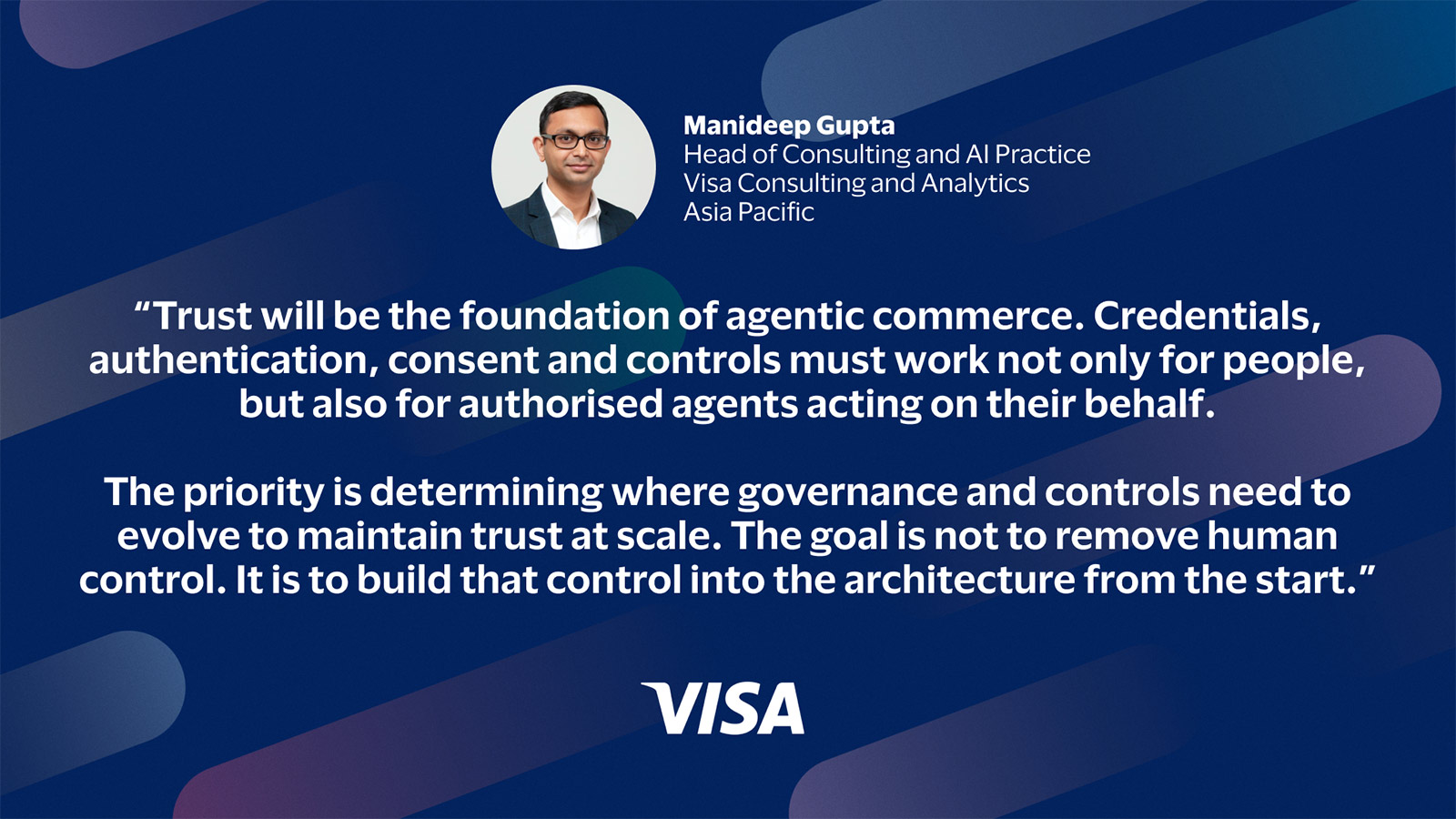
Trust will be the foundation of agentic commerce. Credentials, authentication, consent and controls must work not only for people, but also for authorised agents acting on their behalf. The challenge is not replacing existing infrastructure, but adapting it for a world where customers increasingly delegate decisions and transactions to AI.
As a result, fraud, privacy, model risk, liability, disputes and resilience become part of the same readiness conversation. The priority is determining where governance and controls need to evolve to maintain trust at scale. The goal is not to remove human control. It is to build that control into the architecture from the start.
2. Focus on the opportunities that matter most
Agentic commerce will not reshape every customer journey equally.
While agentic commerce is one of the most visible applications, the broader opportunity lies in agentic AI across banking. Customers may delegate far more than purchases, including financial decision-making, account management, servicing, lending, and other banking activities.
Success will depend less on building sophisticated agents and more on identifying where agent-led experiences solve real customer problems and create measurable business value. This is where data, customer insights and market context become critical in separating promising ideas from lasting opportunities.
For banks, this means deciding where to play: enabling external agents to discover and use bank products, building bank-owned agentic experiences, or applying agentic AI to orchestrate end-to-end banking workflows to continuously optimize customer engagement, product recommendations, portfolio performance, risk and fraud controls, and servicing operations.
3. Scale deliberately
Agentic AI will evolve gradually, moving from recommendations and assisted actions to increasingly autonomous experiences such as customer trust, regulatory clarity and organisational confidence.
The priority is not to build everything at once, but to start with a clear long-term vision for how banking experiences, products, risk decisions and servicing can be orchestrated more intelligently across the customer lifecycle. From there, banks can begin with targeted use cases, learn quickly, and scale what works, with clear metrics across approval rates, conversion, fraud loss, disputes, customer experience, cost-to-serve, and operational efficiency.
Ultimately, for banks across Asia Pacific, the path forward is unlikely to follow a single blueprint. Regulation, digital identity frameworks, customer behaviour and market maturity will shape how adoption unfolds across the region.
While agentic commerce may be one of the first large-scale manifestations, agentic AI represents a broader transformation across products, customer experiences, risk frameworks, operating models and business structures. The organisations that succeed will not necessarily be those that move first, but those that can identify the right opportunities, build trust by design and translate strategy into scalable execution.
Building the infrastructure for accountable autonomy will take time. Visa brings the network, payments expertise and technology capabilities to help clients identify where to begin, establish the right foundations and scale with confidence.