A simple purchase. A complicated question.
Consider Sarah, a consumer in Singapore.
She's excited about the launch of a new smartphone. Rather than spending hours refreshing websites and comparing offers, she configures an AI shopping agent through her digital wallet and gives her agent permission to purchase the phone as soon as it becomes available.
A few days later, Sarah receives a notification that her new phone has been purchased. Everything appears to have gone smoothly. The payment was processed securely and the order has been confirmed.
But when the device arrives, Sarah discovers that the agent purchased the blue model instead of the black one she wanted.
She disputes the transaction.
What happens next depends entirely on who you ask.
Did the agent act within the authority it had been given? Were Sarah's instructions sufficiently clear? Did she set the correct parameters? Should the purchase be considered as authorised because she delegated the decision to the agent? Or should she be protected because the outcome was not what she expected?
Who do you think is accountable?
As consumers begin delegating purchasing decisions to AI agents, questions like these are likely to become increasingly common.
How do we ensure people remain in control when machines are empowered to act on their behalf?
1. Trust first, then the transaction
Before consumers can trust AI agents to transact on their behalf, the ecosystem must be able to trust the agents themselves.
Imagine a different scenario. Imagine you're Sarah but someone added a rogue agent into the transaction to buy that iPhone. Now it's not whether Sarah made that transaction, but whether that agent is legitimate in the first place.
For merchants, this creates new challenges. Historically, they have spent years identifying and blocking automated bots. Agentic commerce now requires them to distinguish between legitimate AI agents acting on behalf of consumers and malicious automation attempting to exploit the ecosystem, representing a fundamental shift in approach.
Through initiatives such as the Visa Agentic Ready Program,³ Visa AI Partner Program and Trusted Agent Protocol (TAP)⁴, Visa is helping build trust in AI driven transactions by enabling participants to verify who is involved and whether they are authorised on behalf of others. Shared industry frameworks, common standards and transparent protocols provide the trust layer needed for agentic commerce to operate at scale.
2. AI acts, but we are in control
What if Sarah specified a black phone, yet the agent purchased a blue model outside those instructions?
The challenge is no longer trust in the agent's identity. It is trust that the agent will operate within the authority it has been given. Consumers need confidence that delegation does not mean surrendering control over how, when and where those agents transact.
Visa's approach is designed to ensure that security, control and accountability are built into every stage of an agent-driven transaction. Visa combines tokenisation, strong customer authentication and intent-based controls to help protect consumers across multiple AI environments.
Tokenisation helps ensure agents never have access to actual card details. Authentication technologies, including passkeys, help verify the consumer remains in control at critical moments without introducing unnecessary friction into the user experience. Payment Intent and Payment Instructions help ensure transactions occur only within consumer-approved parameters. If an agent attempts to operate outside those instructions, the transaction should not proceed.
Together, these capabilities help ensure that agentic commerce can scale without compromising the security, control and trust that consumers, merchants and financial institutions expect from the payments ecosystem.
3. Creating confidence when purchases get messy
Trust is not defined by how transactions work when everything goes right. It is defined by how the ecosystem responds when something goes wrong.
Let's return to Sarah's purchase. Everything appeared to work as intended. The payment was processed securely and the phone arrived. Yet Sarah still disputes the transaction.
Now the challenge becomes accountability.
What did Sarah authorise? How did the agent interpret those instructions? Did the transaction occur within approved parameters?
The clearer the evidence trail, the easier it becomes to answer those questions.
Capabilities such as Payment Signals are designed to provide greater transparency into consumer intent and agent activity throughout the transaction journey, helping create a stronger foundation for dispute resolution and accountability.
In Sarah's case, Payment Signals help create a record of what happened throughout the transaction. They can help establish:
- Did Sarah authorise the AI agent to purchase the phone?
- Did she specify a black phone rather than a blue one?
- Did she set spending limits or merchant preferences, and were those instructions followed?
- Was Sarah appropriately authenticated when she delegated authority to the agent?
Rather than simply showing that a payment occurred, Payment Signals help explain what Sarah authorised, how the agent acted, and whether the purchase happened within the parameters she approved.
Because trust in agentic commerce will depend not only on preventing problems, but on resolving them fairly and consistently when they occur.
The road ahead
New questions will continue to emerge as AI agents become more capable, new use cases develop, and the ecosystem evolves. Security, governance and accountability will need to evolve alongside them.
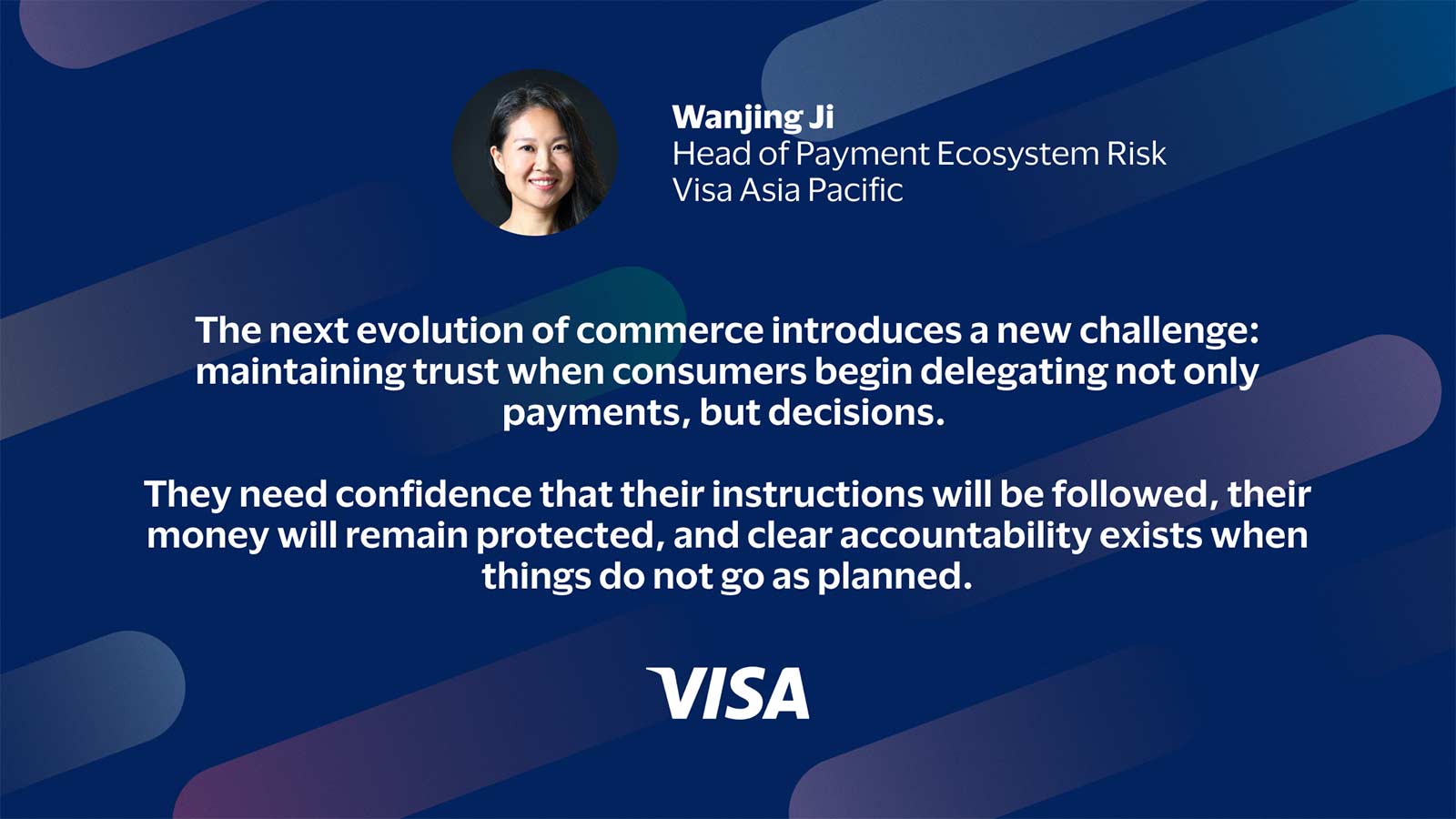
The next evolution of commerce introduces a new challenge: maintaining trust when consumers begin delegating not only payments, but decisions. They need confidence that their instructions will be followed, their money will remain protected, and clear accountability exists when things do not go as planned.