Asia Pacific Travellers Seek Familiarity, Practicality, Flexibility Amid Shifting Global Dynamics: Visa Report
06/16/2026
Visa’s 2026 Global Travel Intentions study shows how Asia Pacific travellers seek trusted destinations, plan with greater intent, and seek flexibility to navigate global uncertainties
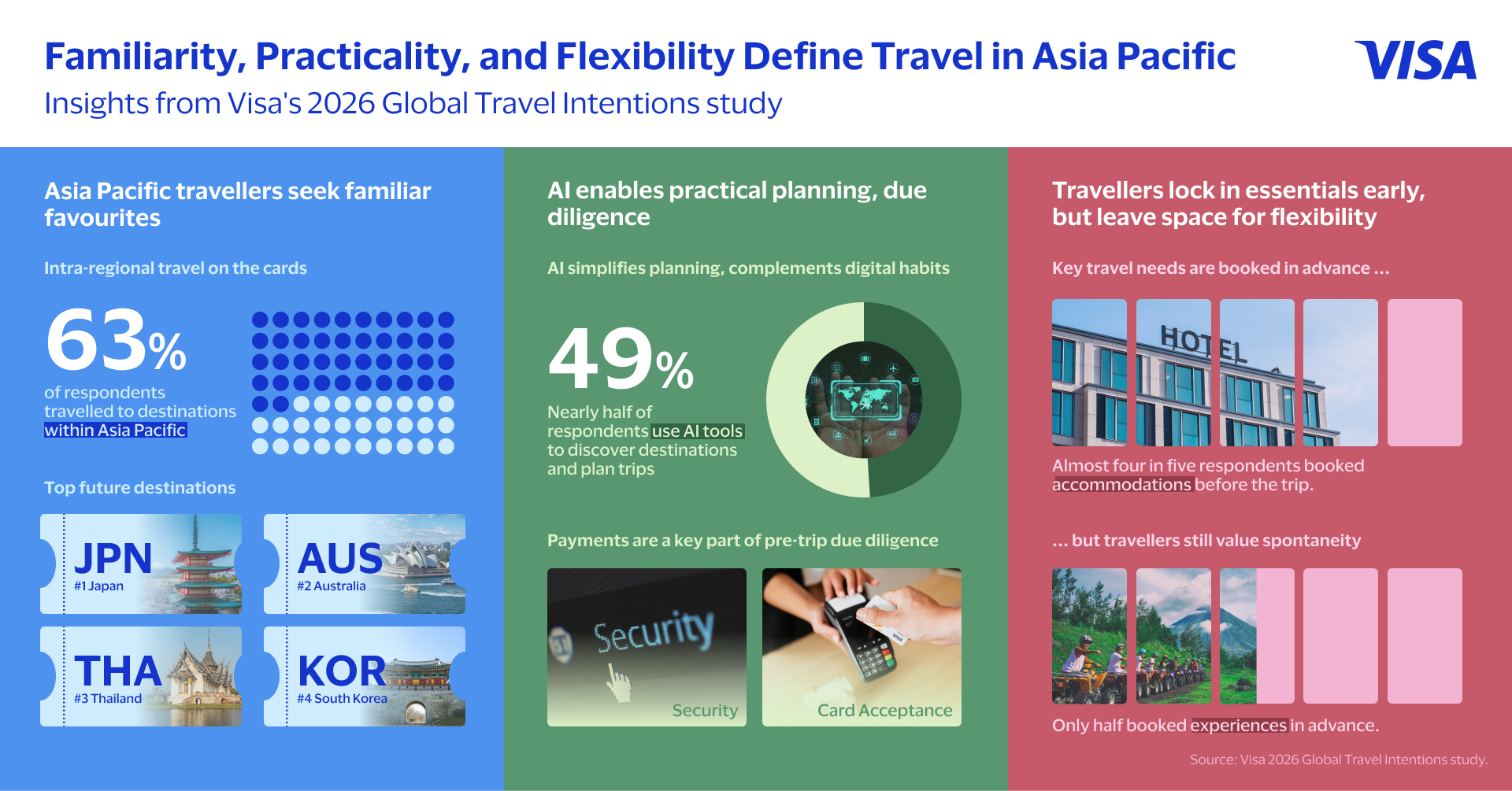
Visa, a global leader in payments, unveils key findings from the 2026 Global Travel Intentions (GTI) study, the latest edition of its flagship global study that has captured global travel patterns and preferences for over 20 years.
The study was conducted among over 47,000 respondents worldwide, including more than 17,000 in Asia Pacific markets. This year’s edition reveals an important finding: Travellers in the region are responding to global shifts not by travelling less but with greater intentionality – focusing on familiarity, practicality, and flexibility.
Asia Pacific travellers seek familiar favourites, but passions guide them
In a global environment shaped by rising costs and uncertainty, Asia Pacific travellers are reconfiguring their travel footprints – choosing to visit destinations closer to home that offer familiarity, ease of access, and confidence in planning.
According to the GTI study:
- 63 percent of respondents surveyed travelled to destinations within Asia Pacific, dwarfing planned travel to Central Europe, Middle East, and Africa (16%), Europe (13%), and North America (6%).
- Japan was the top destination for nearly one in five respondents (19%), followed by Australia (7%). Thailand, South Korea, and Hong Kong round out the top five at about 5 percent each.
- When asked about planned travel destinations in the coming 12 months, more than one in four (28%) still cite Japan as a destination, followed by 16% for Australia, and 13% for Hong Kong and South Korea.
While Asia Pacific travellers turn to familiar destinations, many are still lining up travel plans to discover unique experiences and pursue their passions:
- 37 percent of Asia Pacific respondents plan their trips around unique local experiences, especially those related to food and culture – exceeding the global average of 29 percent.
- One in four respondents said they would travel for major live entertainment and sporting events such as the FIFA World Cup 2026TM, Formula 1TM*, and K-Pop.
AI enables practical planning, due diligence
Travellers in Asia Pacific are also becoming methodical when planning for their trips, at a time when conditions at their travel destinations are fluid. According to the GTI study, travellers in Asia Pacific actively “sense-check” various aspects before their trips, from core needs like accommodations to blind spots like insurance, visa requirements, to monitoring local current events.
AI simplifies pre-trip preparations and complements travel websites and social media as key research channels. Nearly half (49%) of respondents use AI tools to discover destinations and ideas – making it the most frequent use case. Other top uses include:
- Gather and curate travel reviews and recommendations (41%)
- Discover local tours and experiences (35%)
Payments are an essential part of pre-trip due diligence. Payment security is top of mind for respondents (33%), followed by card acceptance at 27 percent. These echo how digital payments are a staple for Asia Pacific travellers, with 73 percent bringing along cards or mobile wallets on their trips.
Travellers lock in essentials early, but leave space for flexibility
While travel planning has become more strategic and deliberate, travel experiences do not become rigid and predictable. Instead, travellers lock in essential bookings early and value spontaneity and are open to changing their plans once they arrive:
- Almost four in five (79%) booked accommodations in advance of the trip
- But only half of respondents (51%) booked experiences in advance, suggesting that travellers keep their options open until they reach their travel destinations
- 72 percent of dining decisions are made after reaching their destinations, while 65 percent of transport choices are made during this stage
Danielle Jin, Chief Marketing Officer at Visa Asia Pacific said: “The latest Global Travel Intentions study affirms the importance of travel to Asia Pacific. Travel is not slowing – it is becoming more planned, purposeful, and intentional. As digital-first travellers seek familiar sights and plan more practically, what matters is how destinations, businesses, and issuers enable every traveller to explore the places they love in their own way, from using AI to help travellers pursue their passions, values, and aspirations to delivering secure and seamless payment experiences at every stage of their journeys.”
To access the full Global Travel Intentions study or learn how to work with Visa, speak to your Visa representative or contact Visa’s Asia Pacific Strategy, Insights, and Analytics team at APInsights&[email protected].
*Formula 1 is a registered trademark owned by Formula One Licensing B.V., a subsidiary of the Formula One Group
About Visa
Visa (NYSE: V) is a world leader in digital payments, facilitating transactions between consumers, merchants, financial institutions and government entities across more than 200 countries and territories. Our mission is to connect the world through the most innovative, convenient, reliable and secure payments network, enabling individuals, businesses and economies to thrive. We believe that economies that include everyone everywhere, uplift everyone everywhere and see access as foundational to the future of money movement. Learn more at Visa.com.
Visa supports global events that inspire people worldwide, from sports and music to fashion and entertainment. As the official payment technology partner of the FIFA World Cup™ since 2007 and through partnerships with the Olympic and Paralympic Games, Formula 1, and Shanghai Fashion Week, Visa enables effortless participation for fans of all ages through seamless and secure transaction experiences, shaping cultural conversations, and driving cross-border commerce.